Corbels vs. brackets vs. cornices at a glance
Corbel | Bracket | Cornice | |
|---|---|---|---|
Form | Individual projecting block, often ornate or carved | L- or scroll-shaped, often with a diagonal brace | Continuous projecting molding |
Orientation | Vertical emphasis; sits beneath a surface | Vertical or angled; projects from a wall or beam | Horizontal; caps the top edge |
Typical placement | Under balconies, entry overhangs, or a cornice | Under eaves, awnings, beams, and overhangs | Where the roof meets the exterior wall |
Role | Mostly ornamental on exteriors | Structural or decorative | Primarily decorative |
Standalone or system | Standalone accent, or placed beneath a cornice | Standalone, or used in lieu of a cornice | Often incorporates dentils, brackets, or corbels |
What are corbels, brackets, and cornices?
These three architectural components may live in similar places on a structure, but they differ in both form and function:
-
Corbels are decorative supports that project from a wall, often seen under shelves, mantels, or balconies. They typically have an ornate, carved appearance.
-
Brackets are L- or scroll-shaped components (often with a diagonal cross brace) that provide structural or visual support under eaves, awnings, or beams.
-
Cornices are projecting moldings that crown a wall or building. They run horizontally and are typically placed at the intersection of the roof and exterior walls.
Now let’s take a closer look at how these architectural details compare to one another.
Corbels vs. brackets
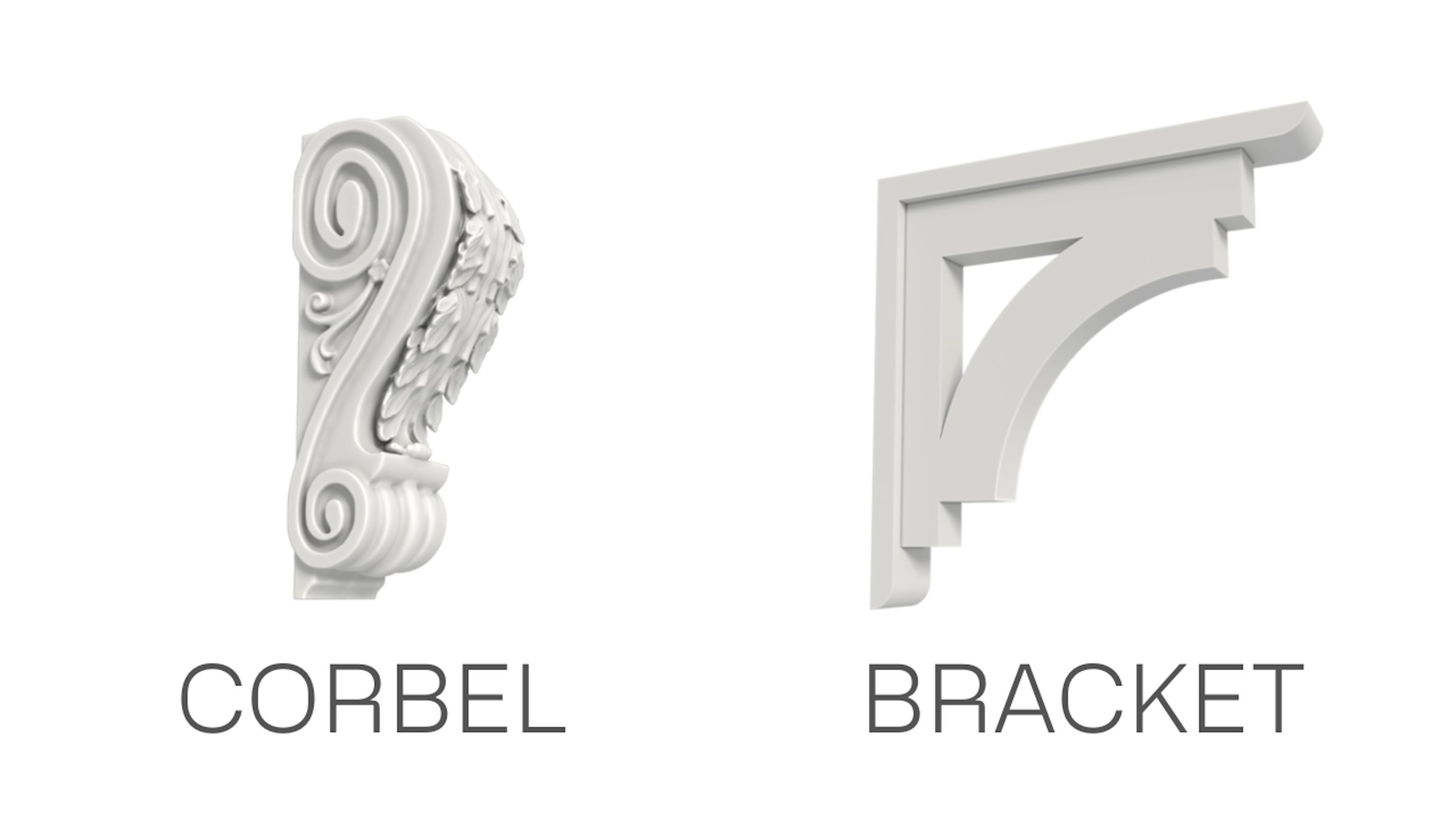
Both corbels and brackets project from a wall to support, or appear to support, something above them, but they differ in scale, ornamentation, and typical use. Corbels tend to be compact, ornate accents, well suited to traditional or classical designs. Brackets are usually larger and more visually prominent, especially under rooflines, overhangs, and eaves.
Corbels are commonly used under balconies and entry overhangs (and, indoors, under mantels and shelving), and are often integrated into a cornice assembly as part of a cohesive trim package. Brackets can stand alone or be used in lieu of a cornice, adding architectural interest and depth without a full molding system. That makes them popular in both traditional and simpler styles like Craftsman or coastal designs.
Brackets vs. cornices
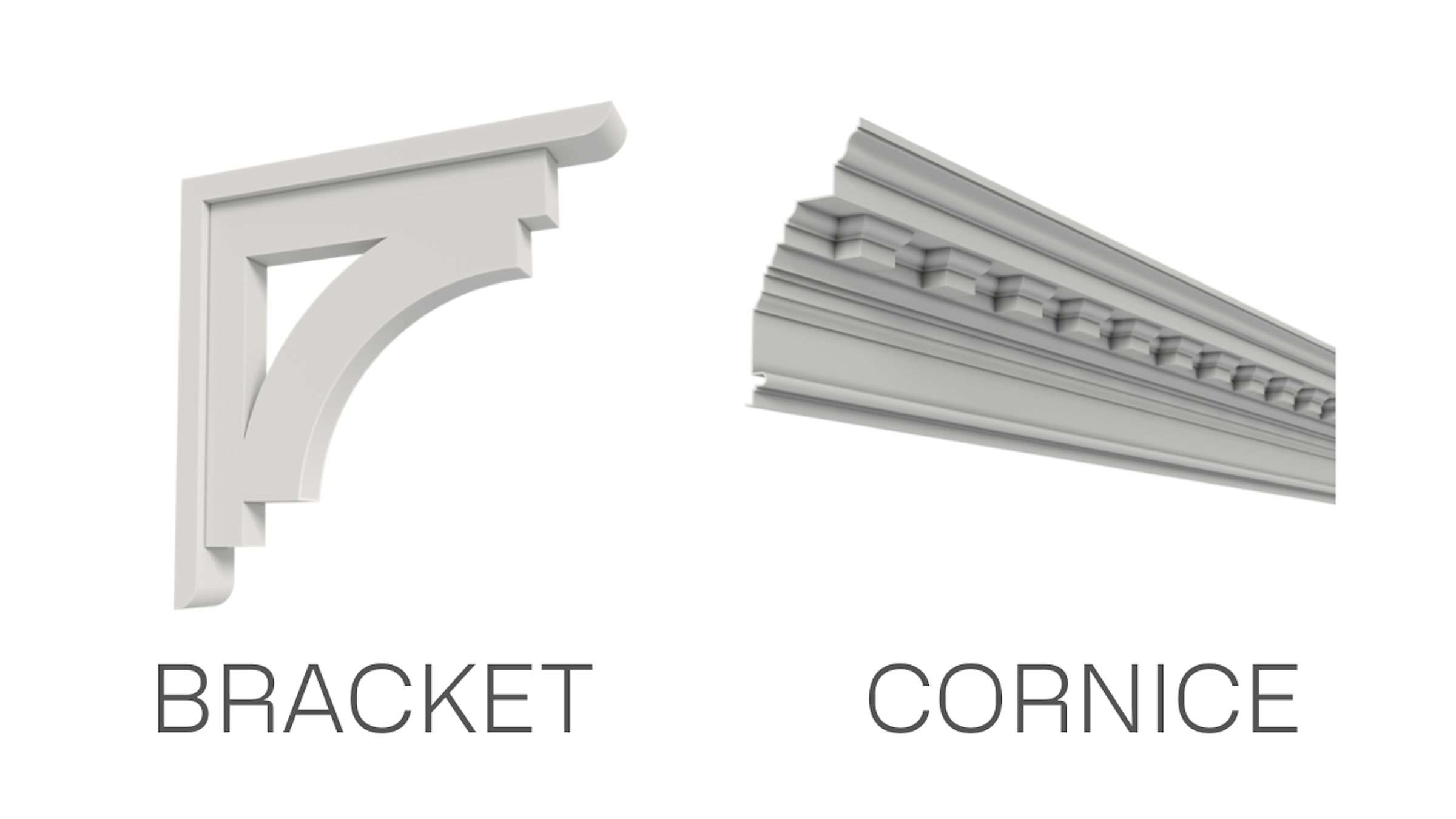
Brackets and cornices may share a roofline, but they serve different roles. Brackets are vertical or angled supports that project from a wall or beam to carry an overhang. Cornices run horizontally and create a visual cap along the top edge.
Brackets add repetition and dimension along an eave, while cornices frame the roofline with molding, dentils, or other linear details. In some designs, brackets are built into a cornice to give the illusion of structural support, but the cornice itself is primarily decorative.
Cornices vs. corbels
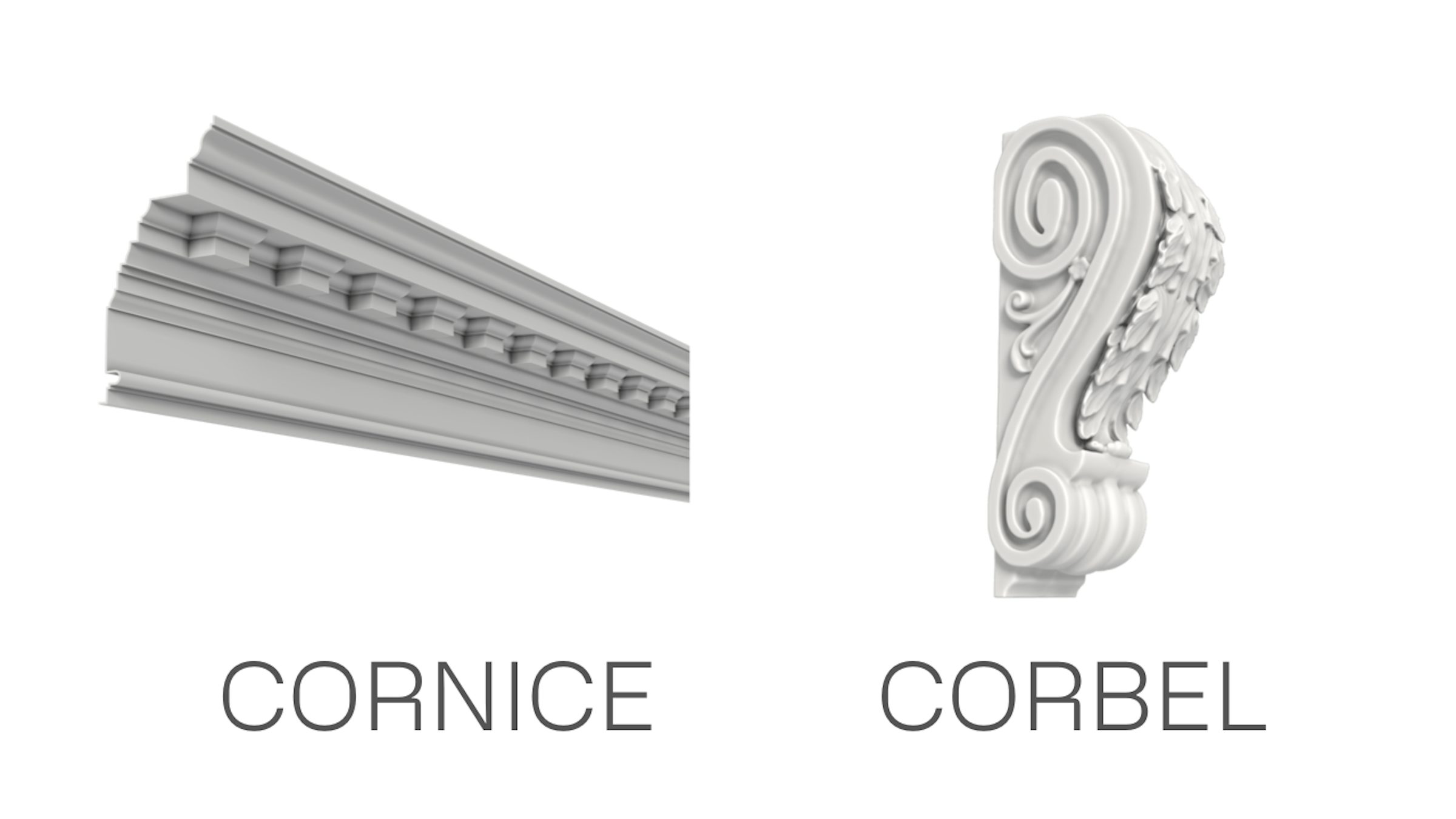
Cornices and corbels both bring a sense of grandeur to traditional architecture, but their forms differ. A cornice runs horizontally, creating a strong visual top-line on a façade or wall section. Corbels are individual projections that sit beneath a surface, creating vertical emphasis.
A cornice may feature a repeating pattern of dentils or moldings, while corbels are often standalone sculptural accents. You can combine the two, placing corbels beneath a cornice for added ornamentation or perceived support.
Are corbels and brackets structural?
Usually not, with one important exception. Most exterior corbels are purely ornamental, and structural support is typically handled by the wall framing or by reinforced brackets. Whether a bracket can carry load depends on the material:
-
Polyurethane brackets and corbels are decorative and should not be relied on to support load.
-
PVC is not load-bearing on its own, but it can be reinforced with aluminum or steel. Decoro uses this approach for structural brackets.
-
Fiberglass and aluminum are structural materials.
-
GFRC is a decorative material and is not rated as structural.
For any application where a bracket must carry load, confirm the specific product and load requirements with Decoro before specifying.
Materials for corbels, brackets, and cornices
Decoro offers these exterior architectural elements in five materials. Each differs in fabrication method, structural capability, and fire rating:
|
Material |
Fabrication |
Structural? |
Fire rating |
Best for |
|---|---|---|---|---|
|
Cellular PVC |
Machined |
Not on its own; can be reinforced with aluminum or steel for structural brackets |
Class A |
Custom profiles and small runs (no mold tooling); oversized brackets |
|
Fiberglass |
Molded |
Yes |
Class A |
Large prefabricated cornice sections and structural requirements |
|
GFRC |
Molded |
No |
Class A, noncombustible |
Projects requiring noncombustible material; masonry or cast-stone aesthetics |
|
Molded polyurethane |
Molded |
No; decorative only |
Class B (combustible) |
Standard profiles and larger production runs; lightweight roofline brackets and moldings (largest standard molding 20" high, bracket 42" high) |
| Aluminum | Machined | Yes | Class A, noncombustible when coil-coated | Noncombustible cornice with a factory finish; no field paint required |
Most Decoro elements can ship unfinished or prefinished to meet exact color and texture requirements. Custom finishes, including stained woodgrain for urethane, are also available.
When to use corbels, brackets, or cornices
Choosing between these elements comes down to both function and aesthetic goals:
| If you need... | Use |
|---|---|
| A decorative accent beneath a balcony, entry overhang, or trim detail | Corbels. Most exterior corbels are purely ornamental. |
| Visual or structural support under an eave, awning, or beam | Brackets. Specify reinforced brackets where they must carry a load. |
| Depth and repetition along an eave without a full molding system | Brackets used in lieu of a cornice |
| A finished cap on a façade or roofline | A cornice |
| Added ornamentation or perceived support beneath a cornice | Corbels placed under the cornice |
Frequently Asked Questions
What is the difference between a corbel and a bracket?
A corbel is a compact, often ornate projection that sits beneath a surface such as a balcony or cornice and adds vertical emphasis. A bracket is an L- or scroll-shaped support, often with a diagonal brace, that projects from a wall or beam under an eave, awning, or overhang. Brackets tend to be larger and more prominent, while corbels tend to be smaller ornamental accents.
Are corbels and brackets structural?
Most exterior corbels are purely ornamental. Brackets can be structural only when reinforced, for example PVC reinforced with aluminum or steel. Polyurethane brackets and corbels are decorative and should not be relied on to carry load.
Can brackets be used instead of a cornice?
Yes. Brackets can stand alone or be used in lieu of a cornice, adding architectural interest and depth along an eave without a full molding system.
What materials are corbels, brackets, and cornices made from?
Decoro offers them in cellular PVC, fiberglass, GFRC, high-density molded polyurethane, and aluminum. The materials table above compares fabrication method, structural capability, and fire rating.
Which materials are noncombustible for cornice and brackets?
GFRC is Class A and noncombustible, and coil-coated aluminum is noncombustible. Molded polyurethane is Class B and combustible.
Specifying corbels, brackets, and cornices
Not sure what a project calls for? Start with the Shape Finder to browse standard options, or talk to our team about a custom design.
Still unsure what your project calls for? Our team is happy to help you evaluate your needs and recommend the right architectural solution, whether it’s one of our standard products, a custom design, or simply guidance in the right direction. Or, check out our shape finder, and discover all the standard options we have to offer.